Tuesday, 16 May 2017

HTC U 11 With 'Edge Sensor' Expected to Launch Today

HTC U 11 With 'Edge Sensor' Expected to Launch Today
HTC U 11 is expected to be launched by the Taiwanese company at its Tuesday launch event, scheduled to begin at 11:30am IST. The event will be live streamed on the company site.
The HTC U 11 has been leaked several times ahead of its launch on Tuesday, and the company itself has teased the Edge Sensor feature, what appears to be an interface powered by pressure-sensitive sensors alongside the smartphone's metal edge. These sensors will respond to squeezing, and perform multiple functions.
The latest leak HTC was an accidental listing of the HTC Edge Sense app on Google Play, revealing what functions the Edge Sense feature will be able to perform. Another report also tipped pricing and a release date as soon as May 19.
As for the HTC Edge Sense app listing, a screenshot accompanying it asked you to test it by pressing the edges to 'fill up a balloon' and release it to launch the balloon. This is essentially to test the feature on the upcoming HTC U 11, and get a sense of how it works. The other screenshots suggest that Edge Sense could work for taking photos, videos, firing up Google Assistant and much more.

Another leak tips the HTC U 11 will go on sale soon after its big reveal. The report claims that the smartphone will go on sale in Taiwan from May 19 for TWD 19,900 (roughly Rs. 42,400). This is really close to the reveal date, and it could also be when HTC kicks-off pre-orders, and not the actual sale.
The smartphone has been tipped to run Android 7.1.1 Nougat, sport a 5.5-inch QHD display, and to be powered by the Snapdragon 835 SoC coupled with 4GB of RAM. In terms of optics, the HTC U 11 is expected to sport a 12-megapixel rear sensor, and a 16-megapixel front camera. It has been tipped to offer 64GB of internal storage as well. There is also a 6GB of RAM/ 128GB built-in storage variant expected to be launched by the company.
The HTC U 11 is also expected to house a 3000mAh non-removable battery with support for Quick Charge 3.0. In terms of connectivity, the phone offers options including 4G LTE (dual-SIM in some markets), dual-band Wi-Fi 802.11 a/b/g/n/ac, GPS with GLONASS, Bluetooth 5.0, NFC, and USB 3.1 Type-C.
The fingerprint scanner on the HTC U 11 is embedded into the home button and the phone is expected to come with water and dust resistance rating of IP57. In terms of audio features, the HTC U 11 is expected to offer HTC BoomSound, Hi-Res Audio, HTC Usonic (Active Noise Cancellation), and 3D Audio Recording.

Samsung Galaxy S8 Launch: 5 Things You Should Look Forward To

Samsung Galaxy S8 Launch: 5 Things You Should Look Forward To


Samsung Galaxy S8 Launch: 5 Things You Should Look Forward To
With just a few hours to go before Samsung officially unveils the Galaxy S8 and Galaxy S8+, there is a lot of hype around the phones right now. With the countless leaks that have surfaced in the past few months, we have a pretty clear idea of what Samsung's next flagship smartphones are going to look like.
The Galaxy S8 has a lot riding on it after the fateful demise of the Galaxy Note 7. Samsung knows that it not only needs to come out with something flagship-worthy, but it also needs to be something special to win over the hearts of fans and skeptics alike. Looking at the leaks, there were a few things that Samsung seems to have been done right:

1. Break the design lull

Smartphone design has seen a bit of a stagnation over the years and Samsung has tried to break that trend in the past by launching dual-edge smartphones. Bezel-less displays are the new order of the day with Xiaomi and LG having raced ahead by launching near bezel-less smartphones with the Mi MIX and LG G6 respectively. Glass is slowly trumping metal as the new premium and if the leaks are right, the Galaxy S8 promises to bring just that - a mostly all-glass smartphone with a large display, and almost no bezels.
All the leaks and renders have shown us that Samsung is keeping the front just for the display, moving the fingerprint scanner over at the back, and ditching the Home Button and navigation buttons altogether. This leaves all the room in the front to house a large display for an immersive viewing experience. The Galaxy S8 allegedly touts a 18:9 aspect ratio with extremely slim bezels on the top and bottom. The back is expected to be all glass as well. From the looks of it, the Galaxy S8 has an attractive design and will offer something different from the current exhaustive lineup of smartphones.

2. Spot on iris scanner

Fingerprint scanners are so 2014, and Samsung wants you to know just that. By now you would have spotted that the fingerprint sensor on the Galaxy S8 is being kept awkwardly close to the rear camera module. One concern here is you could end up accidentally smudging the rear camera every time you try to unlock the smartphone. Not to mention the placement of the sensor could also make it difficult to reach with your finger, especially on the bigger Galaxy S8+. This is perhaps why Samsung has also included an iris scanner, as per leaks.
The company wants you to make use of the iris scanner in the front. But to get this right, Samsung will need to make the technology incredibly fast and responsive. We got a taste of it with the Galaxy Note 7, but we'll know for sure just how useful this can get with the new phones. Additionally, if rumours are to be believed, we may also see a facial recognition feature for added security with the upcoming flagship. If Samsung takes the Apple route, offering extra premium features for 'Plus' models, then the facial recognition feature could be exclusive to the bigger Galaxy S8+.

3. Safest Samsung smartphone ever?

It's about time we move on from those awful "exploding Samsung" jokes and no one wants that more than the South Korean giant. This is perhaps the biggest test for Samsung, and the company would have pulled out all the stops to make sure its units are perfect. Even a single incident - be it legit or otherwise - can potentially hammer the company even worse than before.
After the massive recall of the Galaxy Note 7 that ultimately saw its end late last year, Samsung not only incurred some heavy loss financially but it also took a hit on credibility. Safety is one of the main concerns for the company, and according to reports, Samsung has upped its safety check by adding an eight-point safety check protocol, which includes x-raying the batteries.
As much as Samsung is pushing the boundaries with design, it is also playing it safe when it comes to battery capacity. From the leaks so far, Samsung will limit the battery for the Galaxy S8 and Galaxy S8+ to 3000mAh and 3500mAh, respectively, similar to what was found in the Galaxy S7 and Galaxy S7 Edge.

4. Keeping it under $1000

With a brand new design language for the Galaxy S8 and top-of-the-line specifications and features, the Galaxy S8 and Galaxy S8+ will not go easy on the pockets. As of now, the device are expected to be priced starting at EUR 799 (roughly Rs. 56,000) for the Galaxy S8 and EUR 899 (roughly Rs. 63,300) for the Galaxy S8+. However, a leak out of Italy pegs the Galaxy S8 and Galaxy S8+ at EUR 829 (roughly Rs. 58,500) and EUR 929 (roughly Rs. 65,500), respectively.
These prices are expected to be higher than last year's Galaxy S7. But Samsung fans may be willing to shell out a little extra if the smartphones live up to their expectations. Again, a lot of it will also depend on how the new phones battle the shadow of Galaxy Note 7. Moreover, a pricing over $1000 could be a psychological barrier for fans and Samsung should not cross that bar just yet.

5. Implementing Bixby just right

Samsung will also introduce its personal voice assistant, called Bixby, with the Galaxy S8. Samsung's AI will compete against Apple's Siri. However, the latter has had some years to improve its digital assistant, so Samsung will mostly look to show off Bixby as a smarter version of its S Voice for now. Bixby, developed by Viv Labs, was recently unveiled ahead of the Galaxy S8. According to Samsung, Bixby will let you operate compatible apps completely by voice.
Without a live demo, we still don't know how well Bixby will be integrated in the upcoming flagships. The company says that Bixby-enabled apps will let you complete most tasks using just your voice. Samsung also says that Bixby is more conversational, much like Google's Assistant, and this could give Samsung the edge it needs over Apple.
Samsung Galaxy S8 specifications and features
Bezel-less display and iris scanner aside, the Galaxy S8 and Galaxy S8+ is expected to pack some serious firepower under the hood. The two smartphones will be powered by the latest Snapdragon 835 SoC, but some markets will get the home-grown Exynos 8895 chip as well.
The Samsung Galaxy S8 and Galaxy S8+ are expected to sport 5.8-inch and 6.2-inch Super AMOLED pressure sensitive displays respectively, with QHD+ display resolutions (2400x2960 pixels). The smartphones will pack 4GB of RAM with China and South Korea said to get 6GB RAM variants as well. The devices will run on Android 7.0 Nougat.

Samsung will also look to reclaim its crown in the camera department. The company has done extremely well in this area with recent Galaxy flagships sporting stellar cameras. Interestingly, reports so far tell us that the Galaxy S8 and Galaxy S8+ will get a 12-megapixel dual pixel rear camera. This sounds similar to the Galaxy S7, at least on paper. But you can bet Samsung will add some touches to it that should improve the quality over last year. Samsung is also expected to bump up the front camera to an 8-megapixel sensor.
The Galaxy S8 and Galaxy S8+ will be unveiled in a few hours at an event in the US. You can catch the live streaming of the launch right here.

Display

5.80-inch

Processor

1.9GHz octa-core

Front Camera

8-megapixel

Resolution

1440x2960 pixels

RAM

4GB

OS

Android 7.0

Storage

64GB

Rear Camera

12-megapixel

Battery Capacity

3000mAh

Monday, 15 May 2017

Huawei Takes Honor Brand Offline to Boost Sales, With the Honor 8 Lite

Huawei Takes Honor Brand Offline to Boost Sales, With the Honor 8 Lite


Huawei Takes Honor Brand Offline to Boost Sales, With the Honor 8 Lite


Smartphone maker Huawei on Thursday changed tack by introducing Honor 8 Lite, priced at Rs. 17,999, as the first model from its online Honor stable for retail sale across stores in India to gain volume.
"While both Huawei and Honor have gone from strength to strength in the online space, we feel that it is the opportune time to focus on our offline sales. Online sales only contribute to one-third of total smartphone sales and (the move is) in order to realise our goal of becoming the leading smartphone manufacturer in India," P Sanjeev, Huawei India Consumer Business Group, vice-president - sales, told PTI.
The company has set a target of achieving 10 percent market share in India by 2017-end in the smartphone segment. The move by Huawei signals lower traction for products on e-commerce platforms, which once saw about a million units of various smartphones getting sold in flash sales.
Home-grown smartphone major Micromax too launched its Canvas 2 smartphones on Thursday for sale in the offline market.
According to Sanjeev, Huawei's aim is to strike the ideal balance between online and offline sales.
"We saw immense demand when we first launched Honor products in the offline China market. Keeping that in mind, we decided to replicate the same model in India, which is a very important market for us," Sanjeev said.

According to Counterpoint Research, Huawei led the Chinese market with shipment of 20.8 million smartphones and 19.7 percent market share, followed by Oppo, Vivo and Apple with 17.5 percent, 17.1 percent and 10.1 percent, respectively, in the first three months of 2017.
With the Honor 8 Lite, Huawei is offering 15-month service warranty, along with door pick-up and drop after-sale service to attract offline buyers.
"We have seen a constant rise in the demand for our products in tier 2 and 3 cities, backed by the rise in multi-media usage in such areas. Consumers are now demanding a greater access to devices. There is immense untapped potential in tier 2 and 3 markets and we are now capable of satiating this growing demand and allowing consumers a higher level of access to Honor smartphones," Sanjeev said.
Huawei has till date launched all its Honor series phones on the e-commerce platform and then recently started selling those models across retail stores. Honor 8 Lite is first phone that Huawei will launch and sell offline in India.

Display

5.20-inch

Processor

1.7GHz octa-core

Front Camera

8-megapixel

Resolution

1080x1920 pixels

RAM

4GB

OS

Android 7.0

Storage

64GB

Rear Camera

12-megapixel

Battery Capacity

3000mAh


Xiaomi Redmi 4A Review

Xiaomi Redmi 4A ReviewXiaomi Redmi 4A Review
The Redmi series has anchored Xiaomi in the sub-Rs. 10,000 segment in India. The company launched its first Redmi smartphone, the Redmi 1S, in India in August 2014, and it was received well here. At a recent event, Xiaomi stressed how the Redmi 1S "was a phone way ahead of its time" and claimed that the new Redmi 4A is exactly the same.
That might be true, because other phones in the series including the Redmi 2 (and Redmi 2 Prime) in 2015, and Redmi 3S (and Redmi 3S Prime) in 2016 have impressed us consistently. These models have also been regular fixtures in our lists of the best smartphones under Rs. 10,000.
Xiaomi has already had one big success in 2017, selling over a million units of the Redmi Note 4 within a record 45 days of its launch. The Chinese company hopes to keep that momentum going with the Redmi 4A, which brings features such as VoLTE and a 13-megapixel rear camera to the budget segment. Will the new Xiaomi Redmi 4A be as big a hit for the company? We try to find out in our review.

Xiaomi Redmi 4A design

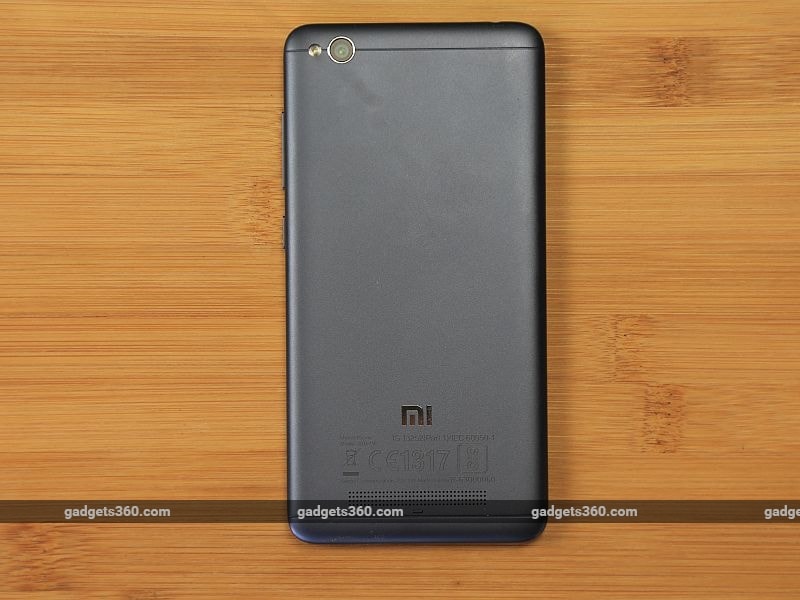
One of the first things you notice when you hold the Xiaomi Redmi 4A in your hands is that despite looking a lot like metal, the body is actually polycarbonate. The rear panel has separate segments at the top and bottom that mimic the antenna bands seen on metal-bodied Redmi models.
The new smartphone closely follows the design language of previous Redmi phones, and buyers in this price segment won't be disappointed. With a relatively small 5-inch screen, the Redmi 4A is compact and therefore easy to use with just one hand. The volume rocker and power button are easily accessible on the right side, while the hybrid SIM slot is on the left. The charging port is on the bottom, and there's a 3.5mm audio jack and infrared emitter on the top.
xiaomi redmi 4a rear gadgets360 xiaomi
The Xiaomi Redmi 4A comes with a charger, Micro-USB cable, warranty card, user guide, and SIM eject tool. As with other Xiaomi products, the Redmi 4A's retail box doesn't include a headset, which might be disappointing for some users. The retail box flaunts a "Made in India" tag. At its launch event, Xiaomi stated that 95 percent of its phones are now manufactured in India.

Xiaomi Redmi 4A specifications and software

The Redmi 4A features a 5-inch HD (720x1280-pixel) display and boasts of a 296ppi pixel density. The company claims that the screen can reproduce 72 percent of the NTSC colour gamut. The display is vivid, and colour reproduction is adequate. We had no problems using the phone under direct sunlight. Text and images appear sharp while videos look good. The Redmi 4A offers a Reading mode which makes colours easier on the eyes, and also allows colour temperature adjustment through the Settings app.
The smartphone is powered by a quad-core Snapdragon 425 processor clocked at 1.4GHz, with integrated Adreno 308 graphics. It has 2GB of RAM and 16GB of storage which can be expanded using a microSD card (up to 128GB). The handset packs a non-removable 3120mAh battery, which the company claims can deliver seven days of standby time. Apart from 4G with VoLTE, the Redmi 4A supports Bluetooth 4.1, Wi-Fi 801.11 b/g/n, GPS/AGPS, and GLONASS.The hybrid dual-SIM slot can hold one Micro-SIM and either a Nano-SIM or a microSD card at one time. When two SIM cards are used, the primary one can support 4G calls and data while the secondary SIM falls back to 2G calls only. The sensors on board include a gyroscope, accelerometer, proximity sensor, and ambient light sensor.
The Redmi 4A runs on MIUI 8 based on Android 6.0 Marshmallow. The company at the launch stressed that there are a lot of features designed for Indian users. MIUI now supports 13 Indic languages including Hindi, Kannada, Tamil, Marathi, Assamese, and Bengali.
On the software front, a lot of features that were seen on previous Redmi phones have made it to the Redmi 4A, including the Dual Apps feature which allows users to create and sign in to two separate instances of any app (like WhatsApp, Facebook, and more) on the same device, and Second Space, which allows users to separate their business and personal data on the same phone. The Second Space feature also allows users to be signed in to two separate Google accounts.
The Redmi 4A allows users to take scrolling screenshots, so for example you can save an entire Web page which doesn't fit on one screen. Some of the other MIUI features include a Child Mode that lets you lock apps; the hovering Quick Ball button which provides quick shortcuts; and One-Handed Mode to shrink the display to one corner of the screen.
The dialler app in the MIUI 8 also has been improved and shows caller ID by default. We need to also give a special mention to the Mi Mover app that lets you move data from another Mi phone. There's a Themes app which lets you pick from a vast collection of wallpapers, ringtones, and fonts, some of which cost money. However, we do wish that Xiaomi could reduce the amount of bloatware on the Redmi 4A since it has only 16GB of storage. There are plenty of 'redundant' apps including Scanner, Mi Community, and Mi Picks. The Redmi 4A also ships with Facebook, Amazon Kindle, WPS Office, Makemytrip, and Flipkart preinstalled.
At its India launch event, Xiaomi also previewed a redesigned messaging app which will change how IRCTC train tickets are formatted on screen. When you receive a confirmation message from IRCTC, Xiaomi's MIUI 8 will recognise it and reformat it to look like an actual ticket, which will be visually refreshing.

Xiaomi Redmi 4A camera performance

The Redmi 4A has a 13-megapixel rear camera with a 5-element lens and f/2.2 aperture. It also has an LED flash, and supports low-light enhancement, HDR, panorama, burst mode, and face recognition. You also get plenty of real-time filters which can be used for fun. There is a 5-megapixel front-facing camera with an f/2.2 aperture as well. You get 1080p and 720p video recording options at 30fps.
The phone's main camera manages to take pretty good shots with decent colours as long as there is enough light around. Shots taken during the day have better details. We were able to focus on objects quickly enough, but noticed that the camera at times struggled with close-up shots. Some of our close-up shots taken with the Redmi 4A ended up with lots of noise.
The rear camera on the Xiaomi Redmi 4A didn't fare too well under artificial lighting, and shots ended up with some amount of noise. Low-light shots tended to have a decent amount of detail, though they were quite grainy. The front camera is able to take sharp and detailed selfies that can be used on social platforms, though it doesn't do well in low light. The phone can record 1080p videos, and the quality is good. The camera app is easy to use, and we liked the fact that access to modes and other things takes just one tap.

Xiaomi Redmi 4A performance

We were fairly impressed with the overall performance of the Redmi 4A. There was no lag when multitasking, and it easily handled switching between multiple apps. We enjoyed streaming videos and movies on the Redmi 4A, but have to admit that the 5-inch screen feels a bit too small since we're so used to bigger phones now.
Gaming on the Redmi 4A was also fun, and we had a good time playing Asphalt 8 and Dead Effect 2. These games initially froze when we tried launching them because multiple other apps were already running at the background. During our review, we noticed that there was roughly 900MB of free memory at any given time, and we did feel that more RAM could have helped.
xiaomi redmi 4a screen gadgets360 xiaomi
The Redmi 4A packs 16GB on board storage out of which users get roughly 10GB of usable space, and this means that we had to rely on expandable storage. The Infrared emitter on the Redmi 4A lets you control various appliances at home and works well with a variety of set-top boxes and TVs.
The loudspeaker on the handset is loud enough to fill a small room, and you should not expect it to outperform phones priced twice as high as this one. Earphones are not bundled with the unit, so we checked audio quality through our own wired earphones, and it was decent. Xiaomi offers various audio tweaking options in the Settings app.
The phone supports video formats like HEVC and MPEG4 among others plus popular audio formats including PCM, AAC/eAAC+, MP3, FLAC, and WAV.
One of the highlights of the Xiaomi Redmi 4A is that it supports VoLTE (voice over LTE), and the handset was able to latch on to networks even in areas with weak signals. Call quality was decent, and we could have long conversations comfortably because of how small and light this phone is. We didn't feel any overheating during our review.
The Redmi 4A got respectable scores in our benchmark tests. It managed 27,567 in AnTuTu, 16,693 overall in Quadrant, 3,684 in 3DMark Ice Storm Extreme, and 13fps in GFXBench's T-Rex test.
The non-removable 3120mAh battery gave us an impressive 12 hours and 35 minutes in our HD video loop test. With heavy real-world usage, the Redmi 4A was a powerhouse, and easily lasted for over a day. It's worth noting that this was without using the power saver mode.
We did try this mode on the Redmi 4A when the battery was down to just 20 percent, and it gave us 8 hours of light usage beyond that. You can choose apps to exempt from restrictions due to the battery saver. We found that the phone took less than two hours to charge fully. Fast charging isn't supported but this shouldn't be a dealbreaker for consumers looking for a smartphone at this price.
Verdict
The new Redmi 4A definitely raises the bar for smartphones at this price level, and we expect it to be very popular. At Rs. 5,999, the Redmi 4A offers a lot of features, especially VoLTE support. Camera performance is decent, and the polycarbonate body, 3120mAh battery, and software are all satisfactory. 
It will be interesting to see how well the Redmi 4A performs compared to the Redmi 3S which is still available at Rs. 6,999. For just Rs. 1,000 more, users can get a metal body, better Snapdragon 430 processor, and more battery power if they choose to buy a Redmi 3S instead.
The Redmi 4A seems to be targeted at first-time smartphone buyers, and for that audience, it seems like a decent option.

Display

5.00-inch

Processor

1.4GHz quad-core

Front Camera

5-megapixel

Resolution

720x1280 pixels

RAM

2GB

OS

Android 6.0

Storage

16GB

Rear Camera

13-megapixel

Battery Capacity

3120mAh

OnePlus 5 Image Leak Tips Dual Rear Camera Setup, 8GB RAM, 4000mAh Battery

OnePlus 5 Image Leak Tips Dual Rear Camera Setup, 8GB RAM, 4000mAh Battery

OnePlus 5 Image Leak Tips Dual Rear Camera Setup, 8GB RAM, 4000mAh Battery
OnePlus 5 is scheduled to launch this Summer but leaks regarding the smartphone have been popping up online with increasing frequency for quite some time now. Now, fresh renders of the phone have surfaced the Internet and suggest that the dual camera setup at the back might feature a different design than suggested earlier.
As per the leaked renders, posted on Chinese microblogging website Weibo (first spotted by TheAndroidSoul), the phone does seem to sport a vertical dual camera setup as suggested earlier but the design appears to be slightly more refined than earlier leaks. The design on the smartphone, from the back side, seems to be somewhat similar to its predecessor OnePlus 3T but as we still have no leaks about what the front looks like.
Interestingly, the new leak also reaffirms some of the specifications that were earlier suggested for the smartphone. This includes presence of Snapdragon 835 SoC, an impressive 8GB of RAM (quite a few reports continue to point to 6GB RAM), and a humongous 4000mAh battery.
Recently, the smartphone's benchmark performance made its way to the Internet and if the leaked GeekBench scores are to be believed, the upcoming flagship from OnePlus outperforms two other smartphones that also feature the Qualcomm Snapdragon 835 SoC. In terms of multi-core performance, OnePlus 5 was able to outperform Samsung's Galaxy S8 and Sony's Xperia XZ Premium.

Display

5.50-inch

Processor

2.45GHz quad-core

Front Camera

8-megapixel

Resolution

1440x2560 pixels

RAM

6GB

OS

Android 7.0

Storage

64GB

Rear Camera

12-megapixel

Battery Capacity

3600mAh

Thursday, 4 May 2017

Xiaomi Redmi 4A to Go on Sale in India Today on Amazon India

Xiaomi Redmi 4A to Go on Sale in India Today on Amazon India


Xiaomi Redmi 4A is set to go on sale in India on Thursday via Amazon, at 12pm IST. At a price of Rs. 5,999, the Xiaomi Redmi 4A will be going on sale in 2GB RAM and 16GB storage configuration.
As before, the smartphone will be available in Dark Grey and Gold colours. Notably, Mi.com will be taking pre-orders on Friday for the Redmi 4A (Review).
For Redmi 4A consumers, Xiaomi had announced an exclusive data offer from Idea for prepaid numbers where users will get 28GB of 4G data with the recharge pack of Rs. 343; the daily cap on data consumption with this pack is 1GB. Apart from data, the Redmi 4A customers will get 300 minutes of free calls per day and 3,000 local and STD SMSes per month. The validity of this recharge pack is 28 days. After 28 days, buyers can again avail the same data, call, and SMS benefits with a recharge of Rs. 343. The offer will expire on June 30, 2017.
Featuring a polycarbonate body, the Redmi 4A bears a hybrid dual-SIM card slot, and runs MIUI 8 based on Android 6.0 Marshmallow. The smartphone features a 5-inch HD (720x1280 pixels) display, and is powered by a 1.4GHz quad-core Snapdragon 425 SoC coupled with the Adreno 308 GPU and 2GB of RAM.
It sports a 13-megapixel sensor with PDAF, a 5-lens system, an f/2.2 aperture, and is backed by a LED flash. There is a 5-megapixel sensor with an f/2.2 aperture on board as well. The Redmi 4A comes with 16GB of inbuilt storage that is expandable via microSD card (up to 128GB).
The Redmi 4A's connectivity options include 4G VoLTE, Wi-Fi 802.11 b/g/n, GPS/ A-GPS, and Bluetooth v4.1. Sensors on board the smartphone include accelerometer, ambient light, gyroscope, infrared, and proximity. Dimensions of the new Xiaomi smartphone are 139.5x70.4x8.5mm, and it weighs in at 131.5 grams. Redmi 4A is powered by a 3120mAh battery with fast charging support.

Display

5.00-inch

Processor

1.4GHz quad-core

Front Camera

5-megapixel

Resolution

720x1280 pixels

RAM

2GB

OS

Android 6.0

Storage

16GB

Rear Camera

13-megapixel

Battery Capacity

3120mAh

New Update

What Miley Cyrus Wrote in Her Letter to Hannah Montana

  Hannah Montana   premiered on the   Disney Channel   on March 24, 2006, meaning that yesterday was the   15th anniversary of the character...